
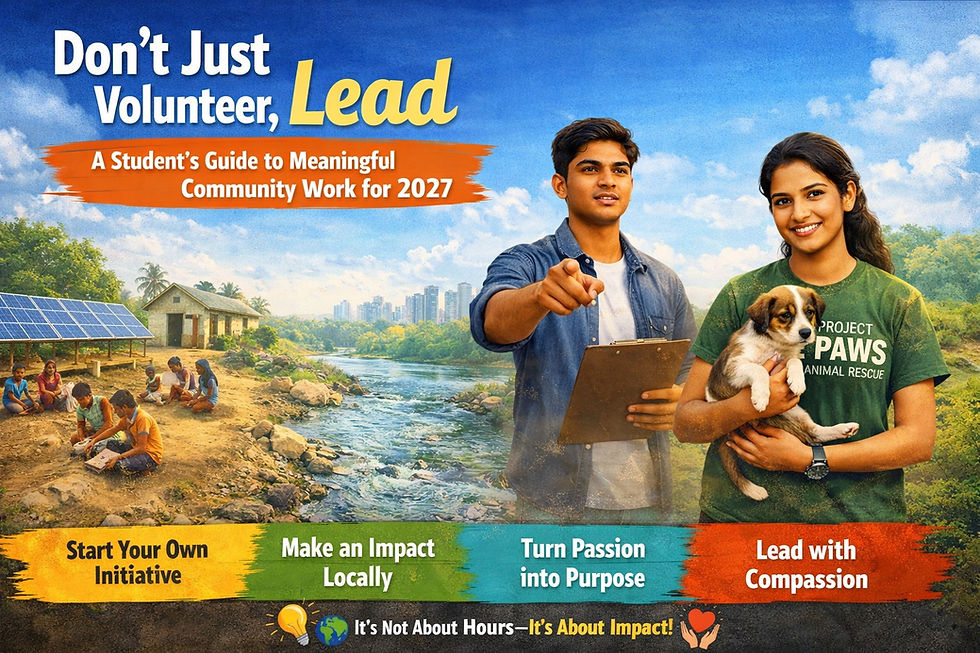
Don't Just Volunteer, Lead: A Student’s Guide to Meaningful Community Work for 2027

“How many volunteer hours do I need for Harvard?”
“Can I count my school’s mandatory 'Social Service' club as my main activity?”
“What if I can't find a famous NGO to work with in my city?”
As counsellors, these are some of the most frequent questions we hear at EZScholar. Parents and students often treat community service like a graduation requirement—a box to be checked with a specific number of hours.
But here’s the truth: Top US universities don't just count your hours; they measure your impact. In a pool of applicants with perfect SAT scores and 4.0 GPAs, meaningful service is often the ‘tie-breaker’. It proves you have the leadership, compassion, and initiative to thrive on a world-class campus.
The Brown Ideal: Brown University looks for students who display ‘a commitment to the community’ through a spirit of independent inquiry—using their own unique initiative to solve societal challenges.
The most successful applicants don't do what ‘looks good’—they do what aligns with who they are. Here is how our students transformed their personal interests into high-impact service.
Scaling Impact in Rural Villages
Prahlad didn't just join an NGO; he built one from the ground up because his community needed it. Living in the small town of Manipal, he realized there was a severe lack of both volunteer opportunities for students and quality education for rural children. Instead of waiting for an opportunity to arrive, Prahlad took the lead and founded NOSFAM. His leadership journey began by addressing this local gap, but it didn't end there. He scaled the initiative by setting up two new chapters in Aurangabad and Kolkata. By the time he transitioned to college, his vision had impacted over 250 children and raised more than 100,000 INR.
How to get involved: If you find a lack of opportunities in your area, follow Prahlad’s lead. Identify a gap in your local community and start a small initiative. You don’t need a global organization to start—you just need a local solution and the commitment to see it through. Start by volunteering as a tutor, then look for ways to expand their reach—perhaps by starting a school club or a digital literacy drive for rural students.
Animal Welfare
For Lekhya, the motivation was simple: ‘To Give Our Streeties A Better Life’. Through her initiative Save Paws, she tackled the stray dog crisis with professional rigour. She didn't just provide food; she organized high-visibility events like ‘Pawathons’ and bake sales to raise over 90,000 INR. These funds directly enabled the vaccination and sterilization of over 50 stray dogs. Rather than just being a silent observer, she stepped up as a community organizer, turning a personal love for animals into a structured mission for public health and safety.
How to get involved: Animal lovers can reach out to organizations like CUPA in Bangalore or follow Lekhya’s model of event-based fundraising. You can help by managing social media to increase adoption rates or organizing local drives to cover medical expenses for injured animals.
The Princeton Philosophy: Princeton’s unofficial motto is “In the Nation’s Service and the Service of Humanity.” They seek students who translate personal interests into a broader commitment to the welfare of others.
Financial Literacy
Aashman identified a massive gap in how government benefits reach those who need them most. Working through ICFL, he conducted numerous seminars and workshops tailored for helpers, maids, drivers, and cooks. He didn't just give a speech; he actively helped 1,000+ individuals navigate the red tape to register for different Government Schemes.
How to get involved: If you have an interest in economics or law, organizations like the Parinaam Foundation focus on eliminating urban poverty. You can start by creating simple, multi-lingual pamphlets explaining basic banking or insurance for the support staff in your own neighborhood.
Health and Advocacy
For Udit, the driving force behind his service was a profound sense of empathy. As he often says, “Knowing that I have helped someone is a feeling beyond comparison.” He spent all four years of high school building Alopecia India, a platform dedicated to helping others navigate the psychological and social challenges of hair loss. By raising $3,200 to donate several high-quality wigs to cancer survivors and alopecia victims, Udit did more than provide a product; he restored their sense of dignity. His initiative focused on helping individuals live with confidence and self-esteem, proving that when compassion meets leadership, the impact is immeasurable.
How to get involved: Interested in healthcare? Chapters of Hair for Hope allow you to organize hair donation drives. If the environment is your calling, look into Goonj or local rewilding projects where you can lead a team of student volunteers.
The MIT Perspective: “Tutoring a single kid in math changes the world. Advocating for change when something doesn't seem fair changes the world. There are thousands of examples.” — MIT Admissions
Mentorship through Sport
Keshav used his time in Grade XI to turn his passion for tennis into a tool for character building. While volunteering at the Bromley Tennis Centre, he took primary school students under his wing. He didn't just teach them how to swing a racket; he organized team-building activities and emphasized sportsmanship and resilience through competitive play.
How to get involved: You can reach out to local sports academies or NGOs like Salaam Baalak Trust that use play as a form of therapy and engagement. Consider starting a weekend sports clinic for underprivileged children in your local park.
Women’s Health & Livelihood
Nayonika dedicated four years to a deeply systemic issue: menstrual hygiene in rural Madhya Pradesh. As a Student Leader for Project Sankalp, she demonstrated exceptional persistence and foresight. She manufactured and distributed sanitary napkins to village women while performing skits to break social taboos around hygiene. Most impressively, she installed napkin-manufacturing machines in the villages, turning a health initiative into a source of sustainable livelihood for several women.
How to get involved: Health advocates can look into The We Foundation, which focuses on hygiene and sustainable community models. You can start by organizing awareness drives or fundraising for sanitary infrastructure in local communities.
The UPenn Approach: Founded by Benjamin Franklin, UPenn values ‘Knowledge for Service.’ Their admissions team looks for students who use their unique skills to strengthen the communities around them.
Environmental Innovation
Ansh proved that environmental service can be both a physical commitment and an entrepreneurial venture. He volunteered every weekend with Namami Gange to clean the Yamuna River, but he didn't stop at just collecting trash. Ansh developed a sophisticated business model that transformed collected plastic waste into sturdy plastic tiles. This innovative approach to sustainability was so impressive it won accolades at both the University of Bristol and Northeastern University.
How to get involved: For those passionate about the planet, organizations like Vrikshit Foundation offers a great starting point. To truly stand out for 2027, look for ways to upcycle the waste you collect or develop a community awareness program that prevents pollution at the source.
The Columbia Connection: Columbia University's mission emphasizes the “advancement of learning... and to convey the products of its efforts to the world.”
Myth-Busters from Admission Officers
To help you navigate the noise of the ‘college prep’ industry, here are the five biggest myths we see families struggle with every year:
Myth 1: “I need a minimum of 200+ volunteer hours to be competitive.”
Reality: Admissions officers don't use a stopwatch; they use a magnifying glass. They are looking for the depth of your impact, not the length of your timesheet. One sustained project where you lead others—like Prahlad founding and scaling his own NGO—is worth more than 500 hours of passive attendance.
Myth 2: “International service trips to exotic locations carry more weight.”
Reality: Universities often prefer local, sustained engagement. Committing to a project over four years—like Nayonika working in rural Madhya Pradesh—shows a genuine, long-term commitment to a community's core needs rather than a one-off ‘voluntourism’ trip.
Myth 3: “My community service must be directly related to my intended major.”
Reality: While alignment is great, universities value character and citizenship above all. Keshav mentored students in tennis; even if he intends to study Engineering, his ability to build community and foster resilience proves he will be a collaborative peer on campus.
Myth 4: “I need to raise a massive amount of money for my project to count.”
Reality: Impact is measured in lives touched, not just currency. While Lekhya raised significant funds, her true success was the 50+ dogs vaccinated. Similarly, Aashman’s impact was measured by the 1,000+ individuals he helped—a result that didn't require a massive bank donation
Myth 5: “I should do as many different activities as possible to show I am well-rounded.”
Reality: Admissions officers prefer a student who dives deep into one or two causes they are truly passionate about rather than someone who spends ten hours at five different charities without ever taking on a leadership role.
EZ Scholar Pro-Tips for 2027 Applicants
Before you start your outreach journey, keep these three strategic tips in mind:
Identify the Right Fit: Don’t pick a cause because it looks ‘impressive’; pick one that you care about enough to stick with for years.
Research and Reach Out: Use our list of vetted NGOs like CRY, The Akshaya Patra Foundation, or Dignity Foundation to find a local chapter.
Commit to Consistency: Admissions officers value a student who shows up twice a month for two years far more than a student who does a one-week ‘service trip’.
Quantify Your Impact: Always keep track of your ‘reach’—how many people helped, how much money raised, or how many hours of service provided.
At the end of the day, your community service is the most personal part of your application. It tells the story of who you are when no one is grading you. In the competitive world of university admissions, your grades and test scores are just the baseline. What truly sets you apart is your humanity and your hustle. The path to a top-tier university isn’t paved with certificates of attendance, but with the genuine desire to leave a place better than you found it. Remember that admissions officers are looking for future leaders and visionaries who aren't afraid to get their hands dirty and engage deeply with the world around them.
Ready to start your journey? We can help you identify local NGOs in your city.
------------------------------------ The End --------------------------------------
Additional Articles
Expert Strategies for Scoring 800 on SAT Math. Ivy League Admissions
Princeton Admissions 2027: SAT Scores, Academic Index & Tier 1 ECs
Admissions to Columbia University 2027: Core Curriculum & Supplemental Essays
Academic Research for Ivy League 2027 Entry: A Student Guide
EZScholar is an expert university admissions consultant and test prep organization which works with bright and ambitious students seeking admissions to Ivy Leagues, Oxbridge, Stanford, MIT, UC Berkeley, University of Toronto and other top global universities. Our experts have helped thousands of students with their profile building, research papers, extracurriculars, co-curriculars, test prep and admissions essays. We provide students with personalized support for applications, essays, and SOPs to ensure their unique voice shines through. Our comprehensive test prep helps students achieve their best possible SAT scores and impress their dream university. Our Bespoke Research Paper program helps differentiate students' university applications, demonstrating a high level of academic curiosity and rigor.



The article makes a good point that meaningful community work is more about genuine initiative and impact than simply collecting volunteer hours. For a quick break from studying or volunteering, Wave Rider is a fast-paced arcade surfing game where you dodge obstacles, collect items, and aim for the longest ride.