
Best Masters in Artificial Intelligence (AI) Programs for 2027 Entry
Updated: Jul 14
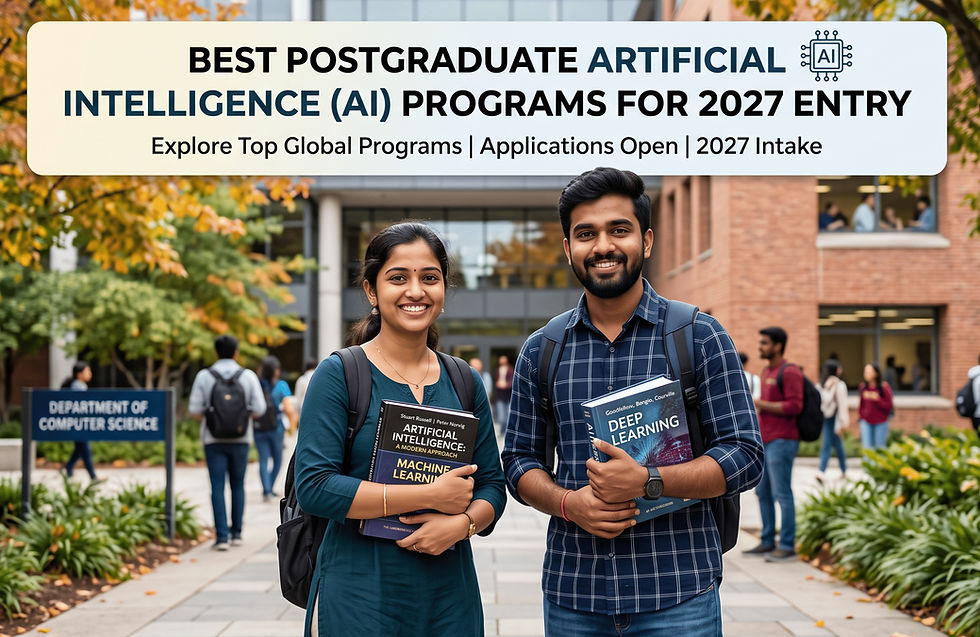
Artificial Intelligence has rapidly evolved from a niche area of computer science into one of the most transformative technologies of the modern era. From large language models and autonomous vehicles to precision medicine, financial analytics, cybersecurity, climate modeling, and intelligent robotics, AI is reshaping industries at an unprecedented pace. As organizations increasingly integrate intelligent systems into their operations, the demand for highly skilled AI professionals continues to accelerate.
While undergraduate degrees provide the foundations of computing and mathematics, postgraduate education allows students to develop advanced expertise in specialized areas such as machine learning, deep learning, natural language processing, computer vision, reinforcement learning, robotics, generative AI, and AI safety. Many leadership positions in AI research, development, and innovation increasingly prefer or require candidates with master's or doctoral qualifications.
For students planning postgraduate study in 2027, a Master's in Artificial Intelligence offers an opportunity to build advanced technical knowledge while gaining access to world-class research laboratories, industry collaborations, and cutting-edge technologies. Whether students aspire to work at global technology companies, contribute to scientific research, build AI-powered startups, or pursue doctoral studies, selecting the right postgraduate program can significantly influence their future career trajectory.
Universities across the United States, United Kingdom, Canada, Singapore, Australia, and Europe now offer specialized AI master's programs that combine rigorous theoretical foundations with practical experience through research projects, internships, industry partnerships, and multidisciplinary collaboration. Many programs also provide opportunities to work directly with leading researchers developing the next generation of intelligent systems.
Choosing a postgraduate AI program, however, involves far more than selecting a university with a high ranking. Students should carefully evaluate curriculum design, research strengths, faculty expertise, laboratory facilities, industry connections, opportunities for internships, dissertation requirements, and long-term career outcomes. A well-chosen program can provide not only technical expertise but also access to a global professional network and some of the world's most innovative research environments.
Who Should Consider a Master's in Artificial Intelligence?
A postgraduate degree in Artificial Intelligence is designed for students who already possess a solid foundation in computing, mathematics, engineering, or quantitative sciences and wish to deepen their expertise. While many applicants come from Computer Science backgrounds, universities increasingly welcome graduates from related disciplines who demonstrate strong programming ability and mathematical preparation.
Common academic backgrounds include:
Computer Science
Software Engineering
Data Science
Information Technology
Electrical or Electronics Engineering
Mathematics
Statistics
Physics
Robotics
Computational Biology
Economics (with strong quantitative preparation)
Some universities also admit applicants from unrelated disciplines who have completed prerequisite coursework in programming, algorithms, linear algebra, probability, and calculus. Students with professional experience in software development, analytics, or engineering may also qualify for conversion or interdisciplinary AI programs. Many of the world’s most prestigious AI pathways are structurally classified as Specializations within an advanced Computer Science framework rather than standalone AI titles.
Academic Foundation
Artificial Intelligence at the postgraduate level is significantly more demanding than simply learning how to use AI tools. Successful students are expected to understand the mathematical principles and computational techniques that power modern intelligent systems.
Typical prerequisite knowledge includes:
Programming (Python strongly preferred)
Data Structures and Algorithms
Linear Algebra
Calculus
Probability
Statistics
Optimization
Basic Machine Learning concepts
Database Systems
Operating Systems (recommended)
Among these subjects, Linear Algebra, Probability, and Optimization form the mathematical backbone of modern AI. Neural networks, transformers, recommendation systems, reinforcement learning, computer vision, and generative models all rely heavily on these concepts. Students should be comfortable with mathematical reasoning, coding complex algorithms, interpreting research papers, and solving open-ended technical problems.
Many competitive master's programs also expect applicants to demonstrate practical experience through research projects, internships, published papers, Kaggle competitions, GitHub portfolios, or industry experience.
Research Master's vs Professional Master's
One of the first decisions prospective students must make is whether to pursue a research-oriented or professional master's degree.
Research Master's
Research-focused programs (with thesis) emphasize independent investigation, advanced theory, and academic research. Students typically complete a substantial thesis under faculty supervision and may contribute to published research. These programs are ideal for students considering a PhD or careers in AI research laboratories.
Professional Master's
Professional or coursework-based master's programs (non thesis) focus on practical skills, industry applications, software development, and applied machine learning. Students usually complete capstone projects, internships, or industry-sponsored research rather than a traditional thesis. These programs are particularly suitable for students seeking careers in technology companies or AI consulting.
Neither option is inherently better. The appropriate choice depends on individual career goals, research interests, and preferred learning style.
Admission Requirements
Although admission requirements vary by university, competitive applicants generally present:
Strong undergraduate academic performance
Programming proficiency (particularly Python)
Mathematics coursework
Letters of recommendation
Statement of Purpose (SOP)
Research experience
Relevant internships or professional experience
English language proficiency (IELTS/TOEFL where applicable)
Some universities may also require the GRE, although many institutions have reduced or eliminated this requirement in recent admission cycles.
A strong portfolio demonstrating AI projects, GitHub repositories, research publications, hackathon participation, or open-source contributions can significantly strengthen an application, particularly when competing for highly selective programs.
United States
The United States remains the global leader in Artificial Intelligence research, innovation, and commercialization. Many of the world's most influential AI breakthroughs have originated from American universities and research laboratories, making the country one of the most attractive destinations for postgraduate study.
Students benefit from exceptional research funding, interdisciplinary collaboration, access to cutting-edge computing infrastructure, and close partnerships with industry. Many master's students work alongside faculty developing state-of-the-art models in machine learning, robotics, computer vision, natural language processing, reinforcement learning, and AI safety.
The American AI ecosystem is also strengthened by its proximity to leading technology companies and research organizations, including OpenAI, Google DeepMind, Anthropic, NVIDIA Research, Microsoft Research, Meta AI, Apple, Amazon, and Tesla. This creates outstanding opportunities for internships, research assistantships, and full-time employment after graduation.
UNIVERSITY | PROGRAM | NOTES |
Stanford University | M.S. in Computer Science (Artificial Intelligence Specialization) | Located in Silicon Valley with unparalleled startup access, venture pipelines, and elite laboratory labs. |
Carnegie Mellon University | Master of Science in Artificial Intelligence and Innovation | Hosted by the top-ranked School of Computer Science; highly selective with intense corporate project integration. |
University of California, Berkeley | Master of Engineering (EECS - AI/Data Track) ) | A rigorous, accelerated professional track combining advanced technical execution with leadership frameworks. |
Georgia Institute of Technology | M.S. in Computer Science (Machine Learning Specialization) | Consistently recognized for delivering world-class computational theory alongside exceptional value. |
University of Washington | M.S. in Information Management(AI Specialization) | Close collaboration with major technology companies in Seattle. |
Pro Tip: Competitive applicants often possess research experience, strong programming skills, and an excellent mathematical foundation. Publications, internships, and open-source contributions can significantly strengthen an application.
Canada
Canada has established itself as one of the world's premier destinations for Artificial Intelligence research. The country played a pivotal role in the modern deep learning revolution, and its universities continue to attract internationally renowned researchers and significant government investment.
Students benefit from collaborative research environments, generous funding opportunities, and outstanding co-op and internship programs. Canada's immigration pathways also make it an attractive destination for international graduates seeking long-term careers.
UNIVERSITY | PROGRAM | NOTES |
University of Toronto | MScAC (Applied Computing - AI Concentration) | Strong links with Toronto's thriving AI ecosystem. |
University of Waterloo | Master of Data Science and Artificial Intelligence (MDSAI) | Excellent co-op opportunities and industry collaborations. |
University of British Columbia | Master of Data Science | Combines machine learning with real-world applications. |
McGill University | M.Sc. Computer Science | Access to Montreal's internationally recognized AI research community. |
University of Alberta | MSc in Computing Science (specialization in Statistical Machine Learning) | World-renowned for machine learning and reinforcement learning research. |
Pro Tip: Co-op placements are one of Canada's greatest strengths. Students who complete industry placements often receive full-time job offers before graduation.
United Kingdom
The United Kingdom has become one of Europe's leading centers for postgraduate AI education. British universities combine rigorous academic training with world-class research and close collaboration with government and industry.
Many master's programs are completed in just one year, making the UK an attractive option for students seeking an accelerated pathway into industry or doctoral research.
UNIVERSITY | PROGRAM | NOTES |
University of Oxford | MSc in Advanced Computer Science(AI specialization) | Flexible program with advanced AI electives and research. |
University of Cambridge | MPhil in Machine Learning and Machine Intelligence | Research-focused program in modern machine learning and AI. |
Imperial College London | MSc Artificial Intelligence | Highly mathematical with exceptional research opportunities. |
University College London (UCL) | MSc Artificial Intelligence and Data Engineering | One of Europe's leading AI programs. |
University of Edinburgh | MSc Artificial Intelligence | Home to one of the world's oldest AI research centres. |
King's College London | MSc Artificial Intelligence | Strong focus on machine learning and intelligent systems. |
University of Southampton | MSc Artificial Intelligence | Excellent industry partnerships. |
University of Manchester | MSc Artificial Intelligence | Flexible curriculum with strong research strengths. |
Pro Tip: UK master's programs are academically intensive. Students should expect a fast-paced curriculum with significant independent study and research.
Singapore
Singapore has rapidly emerged as one of Asia's leading technology and innovation hubs. Significant government investment in AI, smart cities, healthcare technology, and digital transformation has created exceptional opportunities for postgraduate students.
Universities maintain strong partnerships with multinational technology companies and government research agencies, providing students with valuable exposure to real-world AI applications.
UNIVERSITY | PROGRAM | NOTES |
National University of Singapore (NUS) | Master of Computing (Artificial Intelligence Specialisation) | Consistently ranked among Asia's best computing programs. |
Nanyang Technological University (NTU) | Master of Science in Artificial Intelligence (MSAI) | Strong emphasis on machine learning and robotics and AI applications . |
Singapore Management University (SMU) | Master of Science in Business AI (MBAI) | Combines AI with business strategy and industry applications. |
Pro Tip: Singapore offers an excellent balance between academic excellence, industry engagement, and career opportunities across Southeast Asia.
Australia
Australia continues to invest heavily in Artificial Intelligence research across healthcare, mining, agriculture, environmental science, cybersecurity, and autonomous systems.
Many universities emphasize applied research, allowing students to collaborate with industry while completing postgraduate studies.
UNIVERSITY | PROGRAM | NOTES |
University of Melbourne | Master of Information Technology (AI Specialization) | Strong research environment with industry partnerships. |
Australian National University | Master of Computing (Machine Learning) | Research-intensive and highly respected internationally. |
University of New South Wales (UNSW) | Master of Information Technology (AI) | Excellent reputation in computer science. |
Monash University | Master of Artificial Intelligence | Dedicated postgraduate AI program with practical projects. |
University of Technology Sydney | Master of Artificial Intelligence | Strong focus on industry applications and emerging technologies. |
Pro Tip: Australian universities place considerable emphasis on practical experience. Industry projects and applied research can significantly improve graduate employability.
Choosing an AI Specialization
One of the biggest advantages of postgraduate study is the opportunity to specialize. Modern AI is a vast field, and students should think carefully about which area aligns with their interests and career goals.
Specialization | Focus Areas |
Machine Learning | Predictive models, data-driven decision making, recommendation systems. |
Deep Learning | Neural networks, transformers, large-scale AI models. |
Natural Language Processing (NLP) | Chatbots, translation, summarization, generative AI. |
Computer Vision | Image recognition, medical imaging, autonomous vehicles. |
Robotics | Autonomous systems, drones, industrial automation. |
Reinforcement Learning | Game AI, robotics, decision-making systems. |
AI Safety & Ethics | Responsible AI, fairness, governance, alignment. |
Healthcare AI | Diagnostics, drug discovery, medical analytics. |
Finance AI | Algorithmic trading, risk modeling, fraud detection. |
Scholarships and Funding
Many students underestimate the availability of funding for AI studies.
Common funding sources include:
University merit scholarships
Research assistantships
Teaching assistantships
Government scholarships
Industry-sponsored fellowships
AI research grants
Research-intensive universities in the United States and Canada often provide partial or full funding to strong applicants, particularly those with research experience.
Salary Expectations
Compensation for Artificial Intelligence professionals varies depending on the country, specialization, industry, and level of experience. Graduates with expertise in high-demand areas such as machine learning, generative AI, computer vision, and natural language processing often command higher salaries, particularly at leading technology companies.
The United States offers some of the highest entry-level salaries, typically ranging from $120,000 to $200,000+ annually. In Canada, graduates generally earn between CAD 90,000 and CAD 150,000, while salaries in the United Kingdom range from £45,000 to £90,000. Entry-level AI professionals in Singapore can expect SGD 70,000 to SGD 140,000, and those in Australia typically earn AUD 90,000 to AUD 160,000.
While salary is an important consideration, students should also evaluate programs based on curriculum quality, research opportunities, industry partnerships, and long-term career prospects, as these factors often have a greater impact on sustained career growth than initial compensation alone.
Who Should NOT Choose AI?
AI may not be the best fit if you:
Dislike mathematics and analytical thinking.
Prefer memorization over problem-solving.
Do not enjoy programming.
Expect AI to be only about using tools like Google Gemini, Claude
Are uncomfortable with continuous learning.
Want a field that changes slowly.
The Future of AI Careers
Despite concerns that AI may automate jobs, the technology is simultaneously creating entirely new categories of work. The strongest opportunities are increasingly shifting toward people who can build, evaluate, govern, and integrate AI systems rather than simply use them.
Emerging roles include:
AI Engineer
Machine Learning Engineer
Generative AI Specialist
AI Research Scientist
AI Product Manager
AI Safety Researcher
Prompt Engineer
Computer Vision Engineer
NLP Engineer
Robotics Engineer
Artificial Intelligence is no longer a niche specialization. It is becoming a foundational technology that influences nearly every industry, from healthcare and finance to manufacturing, education, transportation, entertainment, and scientific research.
A postgraduate degree in AI can provide exceptional career opportunities, but it is also one of the most demanding fields in modern computing. Success requires strong mathematical foundations, programming ability, curiosity, and a willingness to continuously adapt as the technology evolves.
When choosing a master's program, students should look beyond rankings alone. The best program is often the one that aligns with a student's interests, career goals, research ambitions, preferred learning style, and financial circumstances.
For students who enjoy solving complex problems, building intelligent systems, and working at the frontier of technological innovation, a Master's in Artificial Intelligence can be far more than a degree. It can be an opportunity to help shape the technologies that will define the coming decades.
------------------------------ THE END ------------------------------------------------
Additional Articles
Stanford Admissions Tips 2027: Academic Excellence & Intellectual Vitality
Expert Strategies for Scoring 800 on SAT Math. Ivy League Admissions
Princeton Admissions 2026: SAT Scores, Academic Index & Tier 1 ECs
UCAS 2026 Personal Statement Preparation Section Hacks: 3-Prompt Guide
EZScholar is an expert university admissions consultant and test prep organization which works with bright and ambitious students seeking admissions to Ivy Leagues, Oxbridge, Stanford, MIT, UC Berkeley, University of Toronto and other top global universities. Our experts have helped thousands of students with their profile building, research papers, extracurriculars, co-curriculars, test prep and admissions essays. We provide students with personalized support for applications, essays, and SOPs to ensure their unique voice shines through. Our comprehensive test prep helps students achieve their best possible SAT scores and impress their dream university. Our Bespoke Research Paper program helps differentiate students' university applications, demonstrating a high level of academic curiosity and rigor.



I found this article helpful because it explains router-related information in simple language. Beginners can learn a lot from clear troubleshooting guides like this. Anyone researching 10.0.0.1 can benefit from understanding how to identify the correct router address and access available network settings.
When an app has several versions available online, I think it is better to check the version information carefully instead of downloading the first file that appears. The RaxiWin App latest version keyword is useful for locating information related to the newer release and its installation requirements. After reviewing the details, I looked through the interface and tested a few sections to see how navigation behaved. Pooja prefers applications that remain understandable after updates, and the straightforward menu arrangement made the overall browsing experience easier to follow.
Great insights on AI programs for 2027! As someone with a background in tech, it's fascinating how these advancements can impact fields like tiny fishing. Imagine the data analytics potential—optimizing catch strategies while being eco-friendly!
I always review my information once before using the DM Win Register option.
It only takes a moment and helps avoid basic mistakes.
I just shared this with my CS study group. Ran the link through an og image checker first so the preview picture looked clean in our chat. Appreciate the detailed breakdown!