
The 2027 Guide to Undergraduate Cybersecurity Degrees: Curricula, Entry Requirements and Global Careers
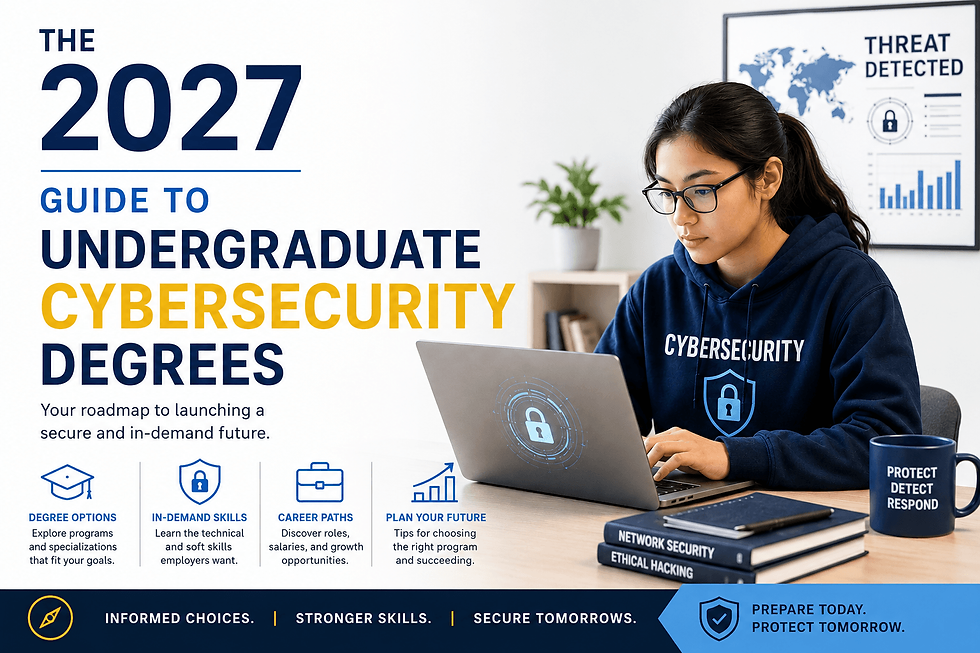
Cyberattacks are no longer isolated IT incidents—they are continuous, system-level threats affecting governments, corporations, and financial systems. Industry estimates suggest ransomware and related attacks occur at extremely high frequency globally, reinforcing cybersecurity as a core pillar of modern infrastructure.
As digital systems expand, the demand for trained professionals has outpaced supply. Current estimates from ISC2 indicate a global workforce gap of approximately 4–5 million professionals, making cybersecurity one of the most resilient and high-impact career paths available today.
The Global Landscape of Cyber Education
Undergraduate cybersecurity education typically follows two primary tracks:
1. Technical Engineering Track
Cryptography
Network security
Penetration testing
Secure software systems
Typical Careers: Security engineer, penetration tester, threat analyst
2. Governance, Risk, and Compliance (GRC) Track
Cyber law and policy
Risk management
Organizational security strategy
Typical Careers: Risk analyst, security consultant, compliance specialist
Accreditation Matters
Families should prioritize:
ABET-accredited computing or cybersecurity-related programs (US)
NCSC-certified degree programs (UK)
These ensure alignment with global industry standards.
The Academic Filter
Engineering-focused programs are mathematically rigorous. Competitive applicants typically demonstrate strength in:
AP Calculus (AB/BC)
IB Mathematics AA HL
A Level Math / Further Math
This foundation is essential for discrete mathematics, algorithms, and cryptography.
Key Countries and Entry Standards
United States
Programs emphasize hands-on labs, simulations, and industry pipelines.
University | Program | Notes |
Georgia Tech | Computer Engineering / CS (Security Threads) | Highly competitive; strong math required |
Purdue University | BS in Cybersecurity | Structured cybersecurity degree |
University of Maryland | CS + Cybersecurity specialization / ACES | Research + security focus |
Arizona State University | IT / CS (Cybersecurity concentration) | Flexible pathways |
UT San Antonio | BS in Cybersecurity | Strong industry links |
International Note: While defense roles require US citizenship, international graduates are actively recruited by cloud providers, finance firms, and consulting companies.
United Kingdom
UK programs offer early specialization with optional placement years.
University | Program | Entry Requirements |
Royal Holloway, University of London | BSc Computer Science (Cyber Security) | IB ~34 |
Lancaster University | BSc Cyber Security | AAB–BBB |
University of York | CS with Cyber Security | AAA or IB ~36 |
Oxford Brookes University | CS for Cyber Security | Moderate entry |
University of Warwick | Computer Science (security modules available) | AAA |
Canada
Programs combine theory with strong co-op systems.
University | Program | Notes |
University of Toronto | Computer Science (security pathways) | High 80s+ |
York University | BSc Cybersecurity | Engineering-focused |
Sheridan College | Applied Cybersecurity Degree | Practical entry route |
Australia
Practical, industry-linked degrees.
University | Program |
Macquarie University | Bachelor of Cyber Security |
Deakin University | Bachelor of Cyber Security |
RMIT University | Bachelor of Cyber Security |
Strengthen Your Application with High-Impact Additions
Top applicants go beyond academics by demonstrating practical engagement:
Capture The Flag (CTF) competitions
Personal security labs or home networks
GitHub projects (e.g., encryption tools, vulnerability scanners)
Certifications such as CompTIA Security+
Admissions officers increasingly value applied curiosity over passive achievement.
Who Should Not Choose Cybersecurity
Cybersecurity is not ideal for students who:
Prefer structured, step-by-step learning over open-ended problem solving
Dislike debugging or working through ambiguous system failures
Are not comfortable with continuous self-learning (tools evolve rapidly)
Success in this field depends more on persistence and systems thinking than raw coding ability.
Strategic Career Benefits & Long-Term ROI
Job Security
With a 4–5 million global workforce gap, cybersecurity roles remain highly protected even during economic downturns.
Flexible Work Structures
Many private-sector roles offer hybrid or remote flexibility, though some positions (especially government-related) require on-site work.
Compensation Premium
Security engineers and ethical hackers often command salaries comparable to senior software developers, particularly in high-risk sectors.
Primary Recruitment Sectors
Enterprise Tech: Google, Microsoft, AWS, CrowdStrike
Finance: JPMorgan, Goldman Sachs, Visa
Consulting: Deloitte, PwC, EY, KPMG, Accenture
Conclusion
Cybersecurity is no longer a specialization—it is a foundational discipline underpinning global systems. It rewards students who combine analytical rigor with adaptability and persistence.
For high-achieving students, the pathway is clear:
Build strong foundations in mathematics and computer science
Demonstrate applied technical initiative early
Develop the ability to think in systems, not just code
In a world where digital infrastructure defines economic and national stability, cybersecurity professionals are not just participants in the system—they are its guardians.
---------------------------THE END-------------------------------
Additional Articles
Academic Research for Ivy League 2026 Entry: A Student Guide
Expert Strategies for Scoring 800 on SAT Math. Ivy League Admissions
UCAS 2026 Personal Statement Preparation Section Hacks: 3-Prompt Guide
EZScholar is an expert university admissions consultant and test prep organization which works with bright and ambitious students seeking admissions to Ivy Leagues, Oxbridge, Stanford, MIT, UC Berkeley, University of Toronto and other top global universities. Our experts have helped thousands of students with their profile building, research papers, extracurriculars, co-curriculars, test prep and admissions essays. We provide students with personalized support for applications, essays, and SOPs to ensure their unique voice shines through. Our comprehensive test prep helps students achieve their best possible SAT scores and impress their dream university. Our Bespoke Research Paper program helps differentiate students' university applications, demonstrating a high level of academic curiosity and rigor.



The gameplay in Undead Corridor is simple to learn but challenging to master. Quick reflexes and smart decision-making are essential for surviving the zombie-infested corridors and reaching new personal bests.
Cybersecurity degrees guide future careers. As a PhD student who works part-time at Last-Minute Assignments, I've seen the demand. I was so strategic that I'd search for help with psychology assignment just to advise. Your post is a roadmap. Thank you for that. Courses, jobs, security. Grateful for the resource. Keep guiding. Seriously, my career path is clearer. Here's to 2027. Thanks for the post. Cheers. Nice post